The store will not work correctly when cookies are disabled.
This website uses cookies to keep you logged in, improve navigation, and anonymously analyze site usage. By using this site or clicking "Allow Cookies", you consent to these cookies on your device.Allow cookies with button below or Learn more.

We use cookies to make your experience better.To comply with the new e-Privacy directive, we need to ask for your consent to set the cookies.Learn more.
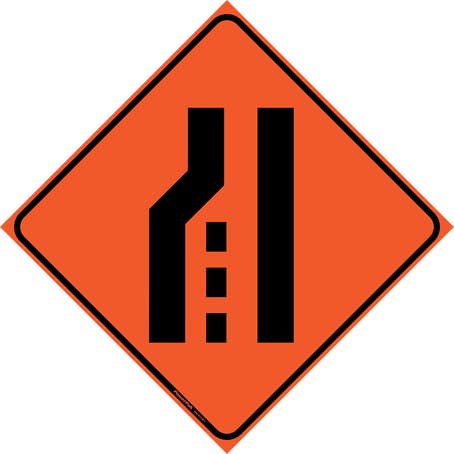
This 48" × 48" Left Lane Merge sign alerts drivers to upcoming lane closures and merge conditions on highways and construction zones. The diamond-shaped warning sign features a black legend on an orange background with Diamond Grade retroreflective sheeting for maximum visibility in all lighting conditions.
Constructed from corrosion-resistant aluminum with 3M Diamond Grade (DG3) reflective sheeting, this sign delivers superior nighttime visibility that meets MUTCD standards for temporary traffic control. The large 48" format ensures adequate recognition distance for high-speed roadways, while the lightweight aluminum construction simplifies handling and installation during work zone setup.
Key Features
Diamond Grade Reflectivity — 3M DG3 sheeting provides industry-leading retroreflectivity for nighttime visibility at highway speeds.
48" × 48" Diamond Format — MUTCD-compliant size for advance warning placement on highways and high-speed arterials.
Aluminum Construction — Lightweight yet durable material resists corrosion and withstands repeated deployment in temporary traffic control zones.
Black on Orange — High-contrast color scheme designated for construction and maintenance work zone warnings.
Pre-Punched Mounting Holes — Standard hole pattern for quick attachment to sign stands, frames, or portable supports.
Applications
Used by DOT contractors, utility crews, and traffic control companies for highway work zones, lane closures, and construction projects requiring advance merge warnings. Ideal for temporary traffic control on interstate highways, state routes, and high-speed arterials where drivers need early notification of lane reductions. Deploy 500–1,000 feet in advance of the merge point depending on road speed and conditions.